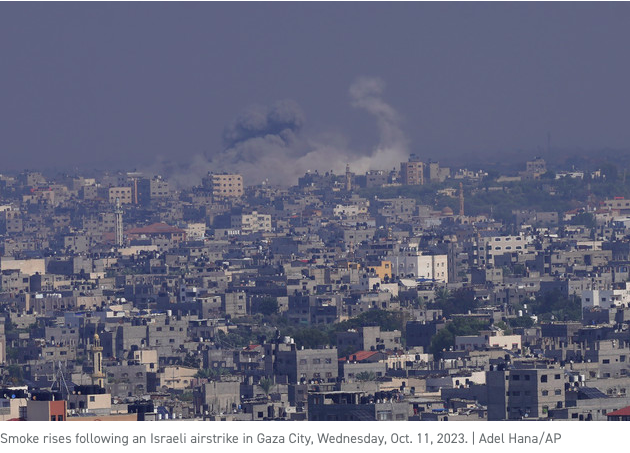
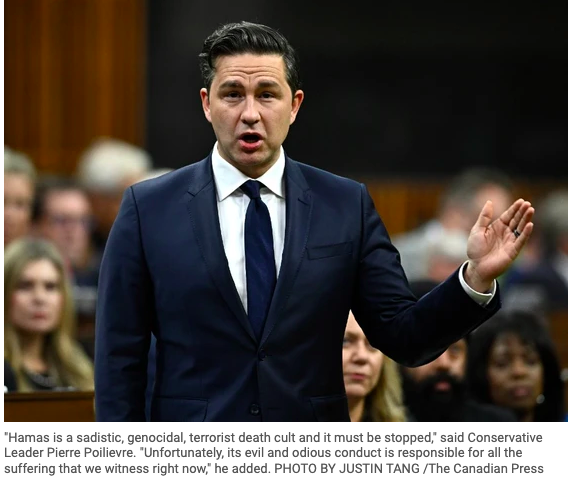
Poilievre calls for 'more severe sanctions' on Iran in response to Hamas attacks

Ottawa must 'take action to counter Hamas any way we can,' the Conservative leader said

US Sanctions Chinese Companies, Turkish Entities Over Iran Drones

Daniel FlatleyBloomberg News

(Bloomberg) -- The US sanctioned Chinese, Russian, Turkish and Iranian companies and people for playing a role in Iran’s drone program a day after five Americans were freed in a prisoner-swap deal with the country.

The Treasury Department added Chinese company Shenzhen Jiasibo Technology Co. Ltd. and its managing director and owner Su Chunpeng to its sanctions list on Tuesday, accusing them of helping a previously designated Iranian supplier of unmanned aerial vehicles acquire parts for radar altimeter systems. Treasury also designated China-based Dong Wenbo for helping to sell aircraft brake disks to the Iranian company.

“The United States will continue to take action against Iran’s UAV procurement networks, and encourages jurisdictions to exercise the due diligence necessary to prevent the export of these components to Iran,” Brian Nelson, the Treasury undersecretary for Terrorism and Financial Intelligence, said in a statement.

The US and European Union have accused Iran of supplying Russia with drones for its war in Ukraine.

The move comes shortly after the Biden administration oversaw the completion of a deal with the Iranian government to release five Iranians held in US custody in exchange for the same number of US citizens. The deal also included the unfreezing of $6 billion in oil revenue held at South Korean banks due to sanctions. 

Earlier: Five Americans Freed in Iran Prisoner Swap Land in Qatar 

Two Turkey-based money exchangers — Mehmet Tokdemir and Alaaddin Aykut — were also designated on Tuesday, along with three Russian aerospace companies. The US said a previously sanctioned Iranian drone company, Iran Aircraft Manufacturing Industrial Company, or HESA, was using the name Shahin Co. in an attempt to evade sanctions, and added that name to its designation. 

©2023 Bloomberg L.P.

Canada sanctions Iran's new national security chief, six drone executives

By The Canadian Press

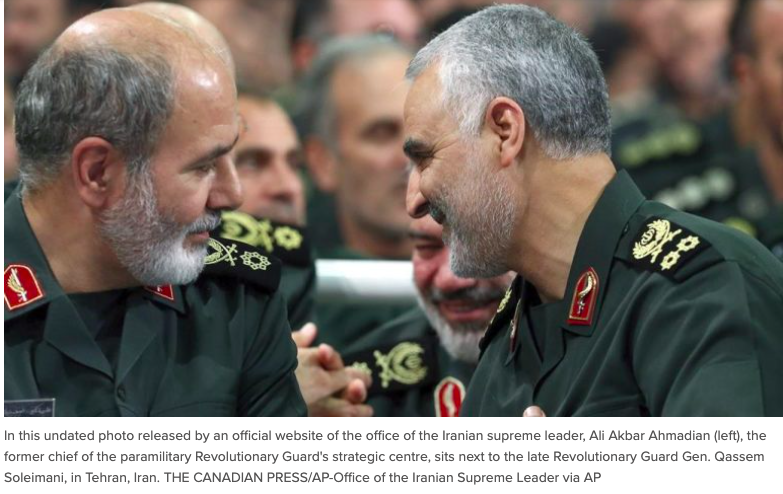
OTTAWA — Canada is sanctioning Iran’s new security chief, alongside six Iranians accused of destabilizing the Middle East and Ukraine.

Ali Akbar Ahmadian, a former commander of the navy division of the Islamic Revolutionary Guard Corps, became chair of Iran’s Supreme National Security Council in May.

Others facing new Canadian sanctions include executives in Iran’s drone industry and aviation sector who are accused of helping sow chaos in Iran’s neighbourhood and supporting Russia’s invasion of Ukraine.

Foreign Affairs Minister Mélanie Joly says the new sanctions aim to keep Ottawa in line with European and American allies, so people facing sanctions don’t see Canada as a safe haven for their assets.

This is the federal government’s 13th round of sanctions against Iranian officials, which aim to prevent them from entering Canada and freeze any assets they hold in the country. 

Critics have said it’s impossible to tell whether Ottawa’s sanctions are having their intended effect, with experts testifying in Parliament that Canada does a poor job of tracking its efforts.

This report by The Canadian Press was first published Aug. 8, 2023.

The Canadian Press

The Canadian businessmen accused of helping Iran's regime

The FBI says they conspired to evade U.S. sanctions on Tehran. These men call those allegations ‘baseless.’

They’re wanted by the FBI in the U.S., accused of helping to disguise hundreds of millions of dollars on Iran’s behalf to evade American sanctions.

In Canada, they’re active businessmen advertising themselves as flourishing leaders in the world of real estate.

Salim Henareh promotes himself on his personal website as the CEO of a private mortgage corporation in Toronto and a “top name in his industry.”

Khalil Henareh (the FBI believes he’s related to Salim) presents himself on social media as an award-winning real estate broker based in Thornhill, Ont.

Saeed (Sam) Torab Abtahi is listed as VP of a private lending company tied to Salim Henareh, according to the company’s website.

They are not accused of violating sanctions in Canada or of any illegal acts here. But all three men face felony charges in the U.S. and up to 20 years in prison if they’re convicted.

Their criminal defence lawyer Barry Fox says the American allegations are “baseless.”

But Garry Clement, a former RCMP superintendent who managed the national police force’s financial crime program, reviewed the U.S. indictment and said it appears to be a “classic example” of Canada acting as a “safe haven.”

“It appears they’re operating with virtual impunity right now,” said Clement. “There doesn’t seem to be a concentrated enforcement action of any kind in this country.”

Prime Minister Justin Trudeau has vowed that Canada will no longer act as a safe haven for people benefiting from “the corrupt and horrific regime in Iran.”

An indictment allows charges to proceed; it is not a conviction.

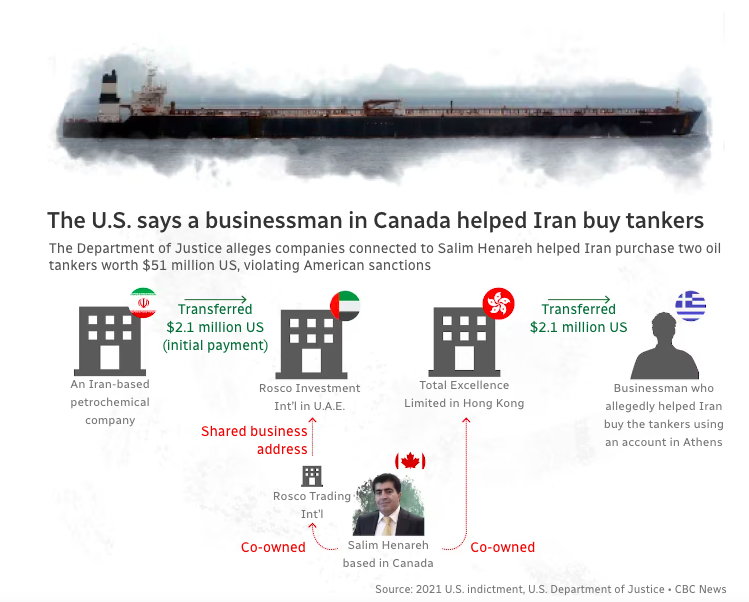
A grand jury in California concluded there was enough evidence in April, 2021 to indict Salim Henareh, Khalil Henareh and Saeed Torab Abtahi for conspiring with at least seven other people to evade U.S. sanctions and disguise transactions on the Iranian regime’s behalf worth more than $750 million US.

The U.S. indictment alleges the sanctions evasion scheme lasted at least from 2002 to 2018 and involved Canadian money service businesses and front companies abroad.

Among other things, the indictment alleges those companies helped to disguise the purchase of two oil tankers worth more than $51 million US on Tehran’s behalf.


Court documents tied to the case claim Iran uses front and shell companies to exploit financial systems around the world and transfer money to support terrorist groups, human rights abuses and ballistic missile development.

Clement said he hopes Canadian authorities are aware of the men’s operations in Canada and that they are looking into them.

“[The U.S. indictment] says to me, look, they’re directly linked to the Iranian regime,” Clement said. “It says to me that they’re prepared to go a great distance to support the regime. And that, in my mind … creates a lot of red flags, and should for Canada.”

Fox said the three men in Canada are not affiliated with Iran’s regime in any way.

“My clients categorically deny having any relationship, personal or corporate, with the Iranian government … the allegations contained in the complaint are without merit,” said Fox in an email.

Fox declined CBC News’ requests for interviews, saying they would have to wait until the U.S. criminal case “is resolved.”

“Since the matter is still pending (although dormant) in the American courts, my clients have no choice but to refuse any form of interview at this time,” Fox wrote.

It’s been almost two years since the indictment was issued.


Salim Henareh

  • Legal name until 2002: Mohammad Salim Henarheshghsou 
  • President of Persepolis Financial Services (1999-2010)
  • President of Rosco Trading International (2008-2021)
  • U.S. accuses both Canadian money services companies of involvement in sanctions evasion scheme 
  • U.S. alleges he created front companies to purchase oil tankers on Iran’s behalf
  • Named as defendant in a handful of civil lawsuits in Ontario —  including a 2017 suit that alleged he and Rosco Trading International breached a contract over issues with a series of wire transfers. The defendants denied any involvement and said it was the plaintiff’s fault.
(Sources: Provincial business records, property records, U.S. court documents, Ontario civil court documents)

Saeed (Sam) Torab Abtahi

  • VP of Rosco Trading International in Toronto 
  • Accused of discussing how to evade U.S. sanctions on Iran by disguising U.S. fund transfers on behalf of Iranian oil companies through front companies and fraudulent invoices
  • 2012 civil lawsuit alleged that Abtahi, Salim Henareh, Rosco Trading International, Persepolis and others “unlawfully and intentionally” converted $1 million of the plaintiff’s money for their own benefit and only paid back $100,000. Court issued a default judgment that was later set aside.
  • Judged a Miss Universe Canada pageant in 2015
  • Studied at McGill University and held senior management positions at Ontario pizza franchises
(Sources: U.S. court records, Miss Universe Canada website, Ontario civil court records)

Khalil Henareh

  • Compliance and operations employee at Rosco Trading International in Toronto
  • Former information and technology and operations manager for Persepolis Financial Investments before it ceased operations
  • Accused of creating front companies and fraudulent invoices that caused U.S. dollar wire transfers to be processed by U.S. banks on behalf of Iranian oil companies
  • U.S. claims he operated some of the websites involved in the alleged sanctions evasion scheme, including one for an Iranian currency exchange business in Tehran
  • Majored in computer science at the University of Toronto
  • Personal website registered to the same hosting site’s address in Arizona as the Lender for Growth and Rosmount Capital Funding websites
(Sources: Khalil Henareh’s website, U.S. court records, Whois domain lookup)
https://www.cbc.ca/newsinteractives/features/iran-sanctions-canada-businessmen#:~:text=The%20Canadian%20businessmen%20accused%20of%20helping%20Iran%27s%20regime

Indictment and Guilty Plea Entered in Iranian Export Case

Department of Justice
U.S. Attorney’s Office
District of Columbia


WASHINGTON – A U.K. man pleaded guilty Tuesday in federal court in the District of Columbia to violations of the International Emergency Economic Powers Act (IEEPA) and Iranian Transactions and Sanctions Regulations. At the same time, an indictment was unsealed charging four individuals with the same offense, as well as related offenses.

According to his plea, Saber Fakih, 46, of the United Kingdom, conspired with Bader Fakih, 41, of Canada, Altaf Faquih, 70, of the United Arab Emirates, and Alireza Taghavi, 46, of Iran, to export and attempt to export an Industrial Microwave System (IMS) and counter-drone system from the United States to Iran, without first obtaining the requisite license from the Department of Treasury’s Office of Foreign Assets Control (OFAC). Fakih pleaded guilty to count two of the indictment.

 “Fakih and his coconspirators attempted to evade U.S. sanctions and obtain highly sensitive pieces of equipment for Iran from unwitting U.S. suppliers,” said Assistant Attorney General Matthew G. Olsen of the Justice Department’s National Security Division. “In doing so, Fakih jeopardized not only U.S. national security, but the national security of any other nation Iran decides to target. The Department of Justice can and will act to disrupt and prosecute such criminal conduct.”

  “This indictment and guilty plea demonstrate the United States’ commitment to preventing U.S. technology with military applications from falling into the hands of the Iranian government, and it demonstrates the effective results generated by the partnership between DOJ, the FBI, the Department of Homeland Security, and the Department of Commerce,” said U.S. Attorney Matthew M. Graves, for the District of Columbia.

 “This investigation illustrates that our adversaries are willing to utilize complicated procurement networks and blatantly disregard U.S. export control laws to acquire sensitive dual use items for potential military purposes, such as counter drone technology, industrial microwave systems, and directed-energy systems that would undermine U.S. national security,” said Special Agent in Charge Nasir Khan of the U.S. Department of Commerce Office of Export Enforcement, Washington Field Office. “The Office of Export Enforcement and our partner agencies will aggressively target and dismantle those illicit networks that seek technological advantages that can be used against us.”

“Mr. Fakih’s guilty plea shows the lengths he went to in order to attempt to procure U.S. technology with military uses, it also shows the lengths the FBI and our federal partners will go to in order to stop these technologies and materials from getting into the wrong hands,” said Special Agent in Charge Thomas J. Sobocinski, of the FBI Baltimore Field Office. “Those who are working domestically and abroad to undermine American interests will be held accountable.”

“The FBI remains committed to protecting U.S. technology and ensuring it does not fall into the hands of anyone intending to use it for harm,” said Assistant Director Alan E. Kohler Jr of the FBI's Counterintelligence Division. “For over 40 years, Iran has continuously attempted to obtain sanctioned items that could be used against Americans or our allies. This indictment of Fakih and his coconspirators sends a clear message: The FBI, along with its federal partners, will persist in thwarting these attempts and do its part to keep our democracy safe.”

“Homeland Security Investigations (HSI) remains committed to safeguarding sensitive U.S. technology and ensuring it does not fall into the hands of our adversaries,” said Special Agent in Charge James R. Mancuso of HSI’s Baltimore Field Office. “This investigation highlights HSI’s global investigative capabilities, and we will continue to work with our federal partners to protect the safety and security of the United States.”   

 In addition, a related indictment was unsealed in the District of Columbia charging Iranian national Jalal Rohollahnejad, 44, with smuggling, wire fraud and related offenses arising from the same scheme. Rohollahnejad was previously added to the Department of Commerce’s, Bureau of Industry and Security Entity List in March 2020, for acting contrary to U.S. national security or foreign policy interests by procuring goods on behalf of a Specially Designated National (SDN).

According to the indictments, in 2017 and 2018, the co-conspirators attempted to export to Iran items that had potential civil and military uses. Potential military uses of the industrial microwave system (IMS) (with some modification) include high-power microwave based directed-energy weapon systems. The counter-drone system, which has both commercial and military uses, can be used to stop, identify, redirect, land or take total control of a target unmanned aerial vehicle.

 The indictments allege that Rohollahnejad and Taghavi hold themselves out as representatives of Rayan Roshd Asfzar, which has been linked to the Iranian Revolutionary Guards Corps (IRGC).

According to court documents, Taghavi informed Fakih that he could not purchase the IMS because he is an Iranian national. Saber Fakih then arranged the purchase of the IMS on Taghavi’s and Rohollahnejad’s behalf, knowing it was ultimately destined for Iran.

 Rohollahnejad caused the equivalent of $450,000 to be sent from Iran to the United Arab Emirates, where Altaf Faquih picked it up and converted it from Emirati currency to U.S. dollars. Faquih then transferred the money to Bader Fakih in Canada via three separate wire transfers. Bader Fakih then transferred the money to the U.S. company for the purchase of the IMS.

 In addition to the IMS, Saber Fakih and Bader Fakih conspired to purchase two counter-drone systems worth nearly $1 million on behalf of Taghavi.

 Saber Fakih faces up to 20 years of incarceration and/or a fine of $1 million for violating the IEEPA. A federal district court judge will determine any sentence after considering the U.S. Sentencing Guidelines and other statutory factors.

The case is being investigated by the FBI’s Baltimore Field Office, HSI’s Baltimore Field Office, and the Washington Field Office of the U.S. Department of Commerce.

The case is being prosecuted by the U.S. Attorney’s Office for the District of Columbia and the Department of Justice National Security Division’s Counterespionage and Export Control Section.

            An indictment is merely an allegation, and all defendants are presumed innocent until proven guilty beyond a reasonable doubt in a court of law.

Accused of helping Iran buy anti-drone systems, Toronto-area man says he’s ‘not a criminal’

Canada sanctions more Iran officials to mark one year since Mahsa Amini's death

OTTAWA - Canada is sanctioning more Iranian officials to mark the anniversary of a young woman's death that sparked global protests one year ago.

Six senior regime officials are banned from entering Canada or having holdings in the country.

Saturday will mark one year since 22-year-old Mahsa Amini died in police custody after being arrested for allegedly not properly wearing her hijab.

The new sanctions echo Canada's allies, and include members of the Supreme Council of the Cultural Revolution, an unelected body that created the so-called morality police that enforce the hijab rules.

Canada is sanctioning Abdol Hossein Khosrow Panah, who took over the group in January and ramped up surveillance of women in Iran.

This is the 14th round of sanctions Canada has imposed on Iran in the past 11 months, aimed at 31 entities and 129 people.

Foreign Affairs Minister Mélanie Joly noted an accelerating crackdown on Iranian women in the past year.

"Today's sanctions reflect our unwavering commitment to stand with the people of Iran, in particular women and girls, as they continue to courageously defend their human rights," Joly wrote in a news release.

This report by The Canadian Press was first published Sept. 15, 2023.

Canadian sanctions against Iranian company don't cover board member with business interest in B.C.

Safiran Airport Services was sanctioned in November for co-ordinating drone transfers to Russia

Federal government banning former Iranian minister from gaining temporary residency

Social media posts circulated earlier this month allegedly showed Seyed Hassan Ghazizadeh Hashemi in Montreal.

Darren Major · CBC News · 

The federal government will deny former Iranian health minister Seyed Hassan Ghazizadeh Hashemi temporary residency following reports that he was spotted in Montreal earlier this summer.

"Based on an assessment of the relevant facts recently brought to my attention, I have exercised my authority under s. 22.1 of the IRPA to prevent Mr. Seyed Hassan Ghazizadeh Hashemi from becoming a temporary resident of Canada for the maximum period of 36 months," Immigration Minister Marc Miller said Monday in a post on X, formerly known as Twitter.

The Immigration and Refugee Protection Act (IRPA), which Miller cited in his statement, allows the immigration minister to deny anyone temporary residency if the minister is "of the opinion that it is justified by public policy considerations."

Miller said his decision was a response to Iran's human rights record.

"The actions of the Iranian regime are reprehensible, and those who bear responsibility have no place in Canadian society," he wrote in his statement.

A number of posts on X began circulating in early August allegedly showing a photo of Hashemi walking in Montreal. 

Iran International, a U.S.-based news outlet focused on the Iranian diaspora, first reported on the photo, claiming it was a screengrab from a promotional video for Quebec's tourism industry. CBC News has not confirmed independently that Hashemi was in Montreal.


A spokesperson for Immigration, Refugees and Citizenship Canada, citing protections under the Privacy Act, said the government can't confirm that Hashemi was in Canada in recent weeks.

Hashemi served as Iran's minister of health from 2013 to 2019 under then-president Hassan Rouhani. He was widely seen as the key official behind the 2014 launch of a plan for universal medical insurance.

Canada announced last year that it would be preventing top members of the Iranian regime — including members of the Islamic Revolutionary Guard Corps (IRGC) — from entering Canada.

That measure, which came into force in November, also fell under the IRPA but only applied to senior officials who were part of the regime from November 2019 onward — meaning Hashemi wasn't covered by it.

Kourosh Doustshenas, a spokesperson for the Association of Families of Flight PS752 Victims, called the move to deny Hashemi temporary residency a "positive" one. But he said he thinks the 2019 cutoff for the IRPA measure brought in last fall is "arbitrary" because Iran's human rights record isn't limited to the past four years.

"They [the regime] have been doing it all the time they've been in power. So why would they chose this particular date? It's kind of puzzling," he said, adding that expanding the time period covered by the measure would prevent former regime representatives like Hashemi from entering Canada.

Doustshenas said it's "disheartening" that someone like Hashemi could have entered Canada easily while Iranian refugees often struggle to get in.

Government 'stands by' its policies

Iranian-Canadian lawyer and human rights activist Kaveh Shahrooz said denying Hashemi temporary residency is a "step in the right direction" — but he argued that his presence in Canada proves federal screening processes should be updated.

"If a former minister whose name can be found in the simplest Google search can slip through the cracks, then I think the cracks are simply too wide," he told CBC News.

"We need to better train our officers, make sure that better due diligence is being done and that the doors are being closed to [Iranian] government officials."

The IRCC spokesperson said the government "stands by" the measures it has invoked under IRPA.

"Canada has designated the regime as having engaged in terrorism and systematic and gross human rights violations, applied sanctions, and in this case have used negative discretion under the Act," the statement said.

CDI condemning the admission of a former Iranian Regime Minister in Canada

August 15, 2023

In a strongly-worded letter addressed to the Minister of Public Safety in Canada, Canadians for Democracy in Iran (CDI) has condemned the presence of a former minister from the Iranian regime on Canadian soil. CDI, an organization dedicated to promoting democracy and human rights in Iran, expressed its deep concern over the individual's presence and called on the Canadian government to ensure accountability.

The former Iranian regime minister, Ghazi Zadeh Hashemi, is believed to have been associated with human rights abuses and repressive policies during their tenure. The CDI's letter emphasized the importance of upholding democratic values and human rights principles, both within Canada and on the international stage.

The CDI's statement underscored the need for transparency and thorough vetting of individuals seeking refuge in Canada, particularly if they have ties to regimes with questionable human rights records. The organization called on the Canadian government to investigate the circumstances of the former minister's presence and take appropriate action in accordance with international norms and values.

Canadians for Democracy in Iran expects the Canadian government to demonstrate its commitment to human rights and democracy by addressing this matter with utmost seriousness. The organization stressed that accountability is essential not only for maintaining Canada's reputation as a safe haven for those fleeing oppression but also for sending a clear message that individuals involved in human rights abuses are not welcome on Canadian soil.

As public attention turns towards this issue, civil society groups, human rights organizations, and concerned citizens are likely to closely monitor developments. The CDI's letter adds to the growing pressure on the Canadian government to address the situation swiftly and transparently.

In the face of these developments, the international community will be watching to see how Canada responds to the CDI's call for accountability and whether the government takes steps to address concerns about the presence of individuals with ties to the repressive regime of Iran within its borders.