
Uproar Follows Video Of Ex-Iranian Minister In Canada

Iran International


A former Iranian minister has been spotted in Montreal, leading to uproar about Canada’s loose immigration controls in allowing entry to regime’s officials. 

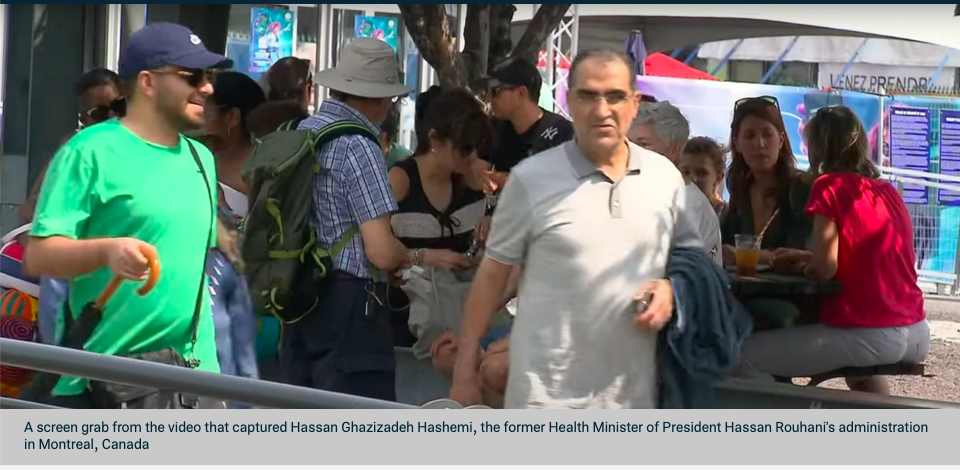
The footage circulating on social media captured Hassan Ghazizadeh Hashemi, the former Health Minister in President Hassan Rouhani's administration, strolling through the streets of Montreal, accompanied by his family. The video is part of promotional materials for Quebec's tourism industry. 

“Canada has designated the Islamic Republic of Iran as a regime that has engaged in terrorism and systematic and gross human rights violations,” Marco Mendicino, former Minister of Public Safety announced in November 2022.

After years of calls by human rights activists and Iranians dissidents, Canada finally announced sanctions last November against Iran’s Revolutionary Guard (IRGC), permanently banning over 10,000 of its officers and other senior officials from entering Canada. 

“We’re using the most powerful tools at our disposal to crack down on Iran's brutal regime. We'll be pursuing a listing of IRGC leadership under our Immigration and Refugee Protection Act, making over 10,000 senior IRGC members inadmissible to Canada,” Prime Minister Justin Trudeau said at the time.  

According to Marco Mendicino, a member of parliament who was the Minister of Public Safety at the time, the entry ban into Canada was not limited to just members of the Revolutionary Guards, but also included heads of state, members of the Cabinet, ambassadors, senior diplomats, members of the judiciary, senior military and intelligence officials and senior public servants. 

No Canadian official has yet commented about Ghazizadeh’s presence but the ban on regime officials “applies to those who were senior officials at any time from November 15, 2019, onwards.” Ghazizadeh was elected as the health minister in 2012 and resigned from this position in January 2017. 

Nevertheless, based on the spirit of the legislation and the designation of the regime as a sponsor of terror, Ghazizadeh’s admission raises questions.

“We’re using the most powerful tools at our disposal to crack down on Iran's brutal regime. We'll be pursuing a listing of IRGC leadership under our Immigration and Refugee Protection Act, making over 10,000 senior IRGC members inadmissible to Canada,” Prime Minister Justin Trudeau said at the time.  

According to Marco Mendicino, a member of parliament who was the Minister of Public Safety at the time, the entry ban into Canada was not limited to just members of the Revolutionary Guards, but also included heads of state, members of the Cabinet, ambassadors, senior diplomats, members of the judiciary, senior military and intelligence officials and senior public servants. 

No Canadian official has yet commented about Ghazizadeh’s presence but the ban on regime officials “applies to those who were senior officials at any time from November 15, 2019, onwards.” Ghazizadeh was elected as the health minister in 2012 and resigned from this position in January 2017. 

Nevertheless, based on the spirit of the legislation and the designation of the regime as a sponsor of terror, Ghazizadeh’s admission raises questions.

A Letter to Prime Minister Trudeau by CDI

May 20, 2023

Rt. Honourable Justin Trudeau, PC, MP

Office of the Prime Minister

80 Wellington Street

Ottawa, Ontario

K1A 0A2

This email address is being protected from spambots. You need JavaScript enabled to view it.

Fax: (613) 941-6900

Dear Prime Minister Trudeau,

We the members of Canadians for Democracy in Iran (CDI), an Ontario registered  nonprofit organization, write to you today with grave concerns regarding the recent executions in Iran.

On Friday, May 19, 2023, the Islamic Republic of Iran, with the execution of three more young men—Majid Kazemi, Saleh Mirhashemi and Saeed Yaqoubi— in Isfahan has continued intensifying use of the death penalty to silence dissent in Iran. Friday's executions brought to 14 the number of protesters hanged since the beginning of the nationwide protests triggered by the death of Mahsa (Jina) Amini last September as part of a brutal and violent crackdown of the protests that have turned into one of the boldest challenges to the clerical rulers since the 1979 revolution.

The Islamic Republic’s death machine is in high gear. Only within the last eight months, well over 500 people have been killed, including 70 children, and nearly 20,000 people have been arrested, jailed and tortured in the hands of the monstrous judiciary of the Islamic Republic of Iran. According to Amnesty International, scores of others face the death penalty in connection with protests.

The arbitrary arrests and executions that date to the first day of this regime’s assuming power are tantamount to deprivation of life under international law, revealing how the Iranian authorities have continued to wield the death penalty as a weapon of repression. The Islamic regime’s contempt for humanity is limitless, and its monstrosity is unfortunately emboldened by the West’s inaction.

Mr. Prime Minister, Iranians, despite such oppression, are continuing their brave struggle for basic human rights and democracy, but they need help. It is therefore of paramount importance that the international community not only stand united with the people of Iran but also take urgent action to hold the Iranian authorities to account.

It remains to add that Canada is uniquely positioned to lead this effort. Not only has Canada steadfastly been most outspoken in condemning human rights violations in Iran, it has also, unlike the majority of other Western countries, severed its diplomatic relation with the Islamic Republic of Iran. Accordingly, Mr. Prime Minister, we urge that your government take the leadership role to demand an immediate halt of all executions and also to step up to investigate the Regime’s officials who have been involved in crimes under international law. Only firm and concrete action by the international community can halt Tehran’s regime from continuing to trample on the basic rights of individuals. The political cost of Iran’s executions must increase.

Sincerely yours

Farrokh Zandi, PhD

Chairman, CDI Board of Directors

CC:       Honourable Mélanie Joly, Minister of Foreign Affairs, This email address is being protected from spambots. You need JavaScript enabled to view it.

             Honourable Pierre Poilievre, Leader of Opposition, MP, pierre.poilievre@parl.gc.ca

Heather McPherson, MP, This email address is being protected from spambots. You need JavaScript enabled to view it.

Ali Ehsassi, MP, This email address is being protected from spambots. You need JavaScript enabled to view it.

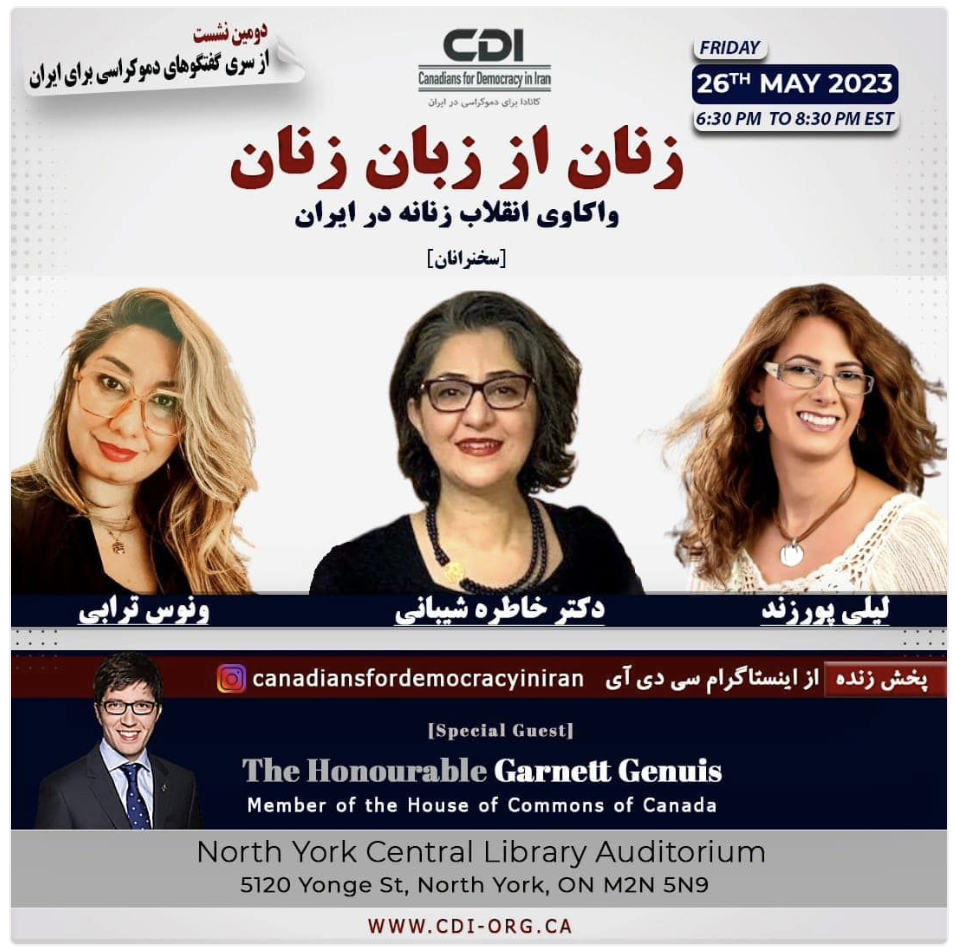
Canadians for Democracy in Iran Second Event

Join us for our second event focused on May 26 at 6:30 pm EST. 

Swedish Parliament Votes To Designate Iran’s IRGC As Terrorist

  • By: Iran International
  • Website: https://www.iranintl.com/en/202305102418

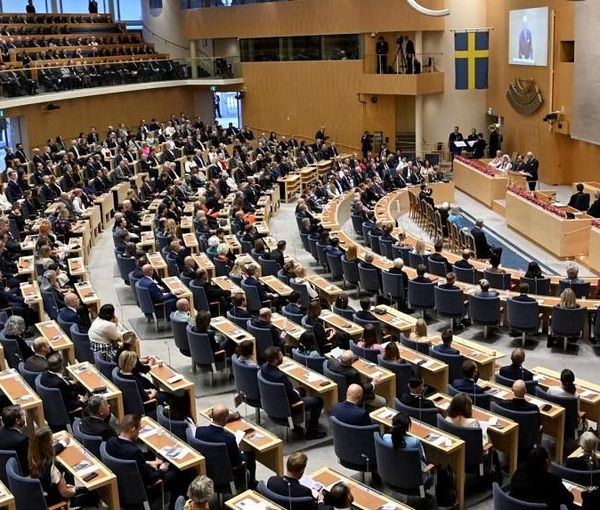
The Swedish Parliament voted in favour of designating the Islamic Revolutionary Guard Corps (IRGC) as a terrorist organization today [May 10].

It followed the execution this week of Swedish-Iranian Habib Chaab (Asyud) which saw Sweden's Ministry of Foreign Affairs summon Iran's charge d'affaires in protest of the execution, one of hundreds since the start of the year.

Iran's relations with Sweden have been strained since July when a Swedish court sentenced a former Iranian jailor, Hamid Nouri, to life imprisonment over executions of political prisoners in 1988.

The European Parliament overwhelmingly passed a resolution in January calling on the EU and member states to designate Iran’s Revolutionary Guard as a terrorist group.

The resolution demanded Iranian authorities end the crackdown on popular protests that started last September after a 22-year-old woman was killed in hijab police custody.

It also demanded that Europe should sanction the Islamic Republic’s Supreme Leader Ali Khamenei and its president Ebrahim Raisi.

Despite numerous requests and rallies by Iranians living abroad, the European Union has not yet proscribed the IRGC.

The United States designated the IRGC as a global terrorist organization in 2019. It has carried out multiple cyber-attacks and threats to the lives of Iranians abroad, including staff at Iran International based in the UK.

CDI's Letter to the Prime Minister of Israel

May 3, 2023

His Excellency Benjamin Netanyahu

Prime Minister of Israel

C/O Embassy of Israel in Ottawa

This email address is being protected from spambots. You need JavaScript enabled to view it.

Dear Prime Minister Netanyahu:

Canadians for democracy in Iran, CDI, strongly condemns the letter signed by 32 Israeli Knesset deputies to provide international support to the “south” Azerbaijani “independence” movement, a region in northern Iran. We consider signing this letter as a serious violation of Iranian territorial-integrity which cannot be tolerated by the Iranian people.

As Iranians living in diaspora and exile, we are outraged by this misguided statement, and we will never recognize a separatist initiative against our homeland’s territorial integrity under the false narrative that “an international support to corroborate any separatist movement within Iran will deal a serious blow to the regime of Tehran.”

While we are aware that the above letter has been partially withdrawn with the intervention of Ms. Gila Gamliel, the Intelligence Minister of Israel, we still need to address the issue and call it out to intercept potential future mishaps or misunderstandings in this regard.

CDI believes that what the undersigned Knesset members have formulated in their letter as supporting “the national aspirations of the peoples of south Azerbaijan [...] [and] if a sovereign state south Azerbaijan is created, Israel will get another ally in the region along with the Azerbaijan republic” is problematic in several lights:

  1. There is no “south” Azerbaijan in Iran. Considering “southern” Azerbaijan is falsely or intentionally implying a territorial independence from Iran, subsuming an attachment with the Azerbaijan republic and its jurisprudence that is technically outside the borderlines of Iran.
  2. Iran is made up of several ethnicities (including Azeris), distinct by their cultural and linguistic heritage, who have been an integral part of Iran (Persia) for thousands of years. Such cultural uniqueness, however, has never translated into separatist sentiments in the mind and mouth of Iran’s people of diverse ethnic backgrounds. Nor can it be envisaged to be the mentality behind our resistance against the murderous regime in Tehran. While we appreciate the way systematic discrimination against our fellow Azeri or other ethnicities in Iran is being called out internationally, no gesture, request, movement, or initiative that may push the narrative of separation and independence under the guise of international support is either appreciated or allowed.
  3. We understand how Israel can be an incontrovertible asset for the Iranian opposition to advance their anti-Islamic Regime initiatives. However, carving out a potential ally for Israel through separating a province of Iran and assuming its attachment to the Azerbaijan republic would erect the Iranian opposition against such pro-independence instigators. This would wound the ties between the opposition to the Islamic regime and the Israeli Knesset.

Mr. Prime Minister, CDI wholeheartedly supports any process that restores a partnership between the two countries of Iran and Israel and rekindles the historical friendship that has existed between our two peoples.

Respectfully,

Farrokh Zandi

Chair, CDI Board of Directors

CC: His Excellency Eli Cohen, Minister of Foreign Affairs, State of Israel

Institute for Voices of Liberty- Letter to the Prime Minister of Israel

Letter to the Prime Minister of Israel by Reza Moridi

Canadians for Democracy in Iran Event

Join us on April 28, 2023 from 6:00 PM to 8:00 PM EST for our event. 

Canada Adds 12 Names to Iran Sanctions List

  • By: Peter Zimonjic
  • Source: CBC News
  • Website: https://www.cbc.ca/news/politics/canada-adds-iran-sanctions-1.6761687

Foreign Affairs Minister Mélanie Joly has announced the federal government is adding 12 senior Iranian regime officials to its sanctions list — individuals Ottawa says participated in "gross and systematic human rights violations in Iran."

"The Iranian regime continues to brutally oppress its people and to deny them their fundamental rights and freedoms," Joly said in a media statement.

"We hear the pleas of the Iranian people and we commend them for their bravery and resilience. Canada will not stop advocating for Iranians and their human rights."

In reaction to the Iranian regime's crackdown on human rights protesters last fall, the Canadian government introduced a number of sanctions against Iranian individuals and entities. These latest additions to the list mark the ninth round of sanctions. 

Global Affairs Canada (GAC) has listed key agents of the Iranian regime, including the Islamic Revolutionary Guard Corpsm (IRGC) and more than 10,000 senior IRGC officials, as inadmissible to Canada.

The 12 senior officials added to the list Monday include members of the IRGC and Iran's Law Enforcement Forces (LEF), which GAC says has been involved in the "lethal suppression of demonstrations across Kurdish areas of Western Iran."

Also on the list of 12 are: 

  • Morteza Mir Aghaei, commander of Basij paramilitary forces in Sanandaj, Kurdistan Province.
  • Esmaeil Zarei Kousha, governor of Kurdistan Province.
  • Seyeh Sadegh Hosseini, IRGC general and commander of the IRGC's Beit al-Moqqadas Corps in Kurdistan Province.
  • Rahim Jahanbakhsh, LEF second brigadier general and commander of the LEF in West Azerbaijan Province.

The federal government said that adding these individuals to the sanctions list today bans them from entering Canada and prohibits any dealings with them. It also means any assets they may hold in Canada have been frozen.

A bloody crackdown

The recent unrest in Iran was sparked by the death of 22-year-old Mahsa Amini after she was arrested by Iran's morality police in September for not wearing her headscarf properly.

The protests that ensued after her death in police custody represent one of the biggest challenges to the Islamic Republic since its establishment in 1979.

The Basij force, affiliated with Iran's powerful Revolutionary Guards, has been behind much of the crackdown against protesters.

According to Human Rights Activists in Iran, a group that has been tracking the human toll of the regime's crackdown on protesters, almost 20,000 people have been arrested and more than 500 have been killed since protests began. 

Canada has sanctioned 139 Iranian individuals and 189 Iranian entities, including the IRGC and the regime's security intelligence and economic apparatus.

Tehran's military aid to Moscow during the current war in Ukraine — Iran has supplied Russia with its own drones, for example — has also angered the West.


The Fractured Opposition to the Islamic Regime

  • By: Ata Hoodashtian
  • Source: Fikra Forum
  • Website: https://www.washingtoninstitute.org/policy-analysis/fractured-opposition-islamic-regime

The Iranian opposition has aligned itself well with the recent protest movement, but evidence of its ability to play an organizational or leadership role in future protests remains limited.

Iranian Opposition Forces

The “Women, Life, Freedom” protests that were sparked by the death of Mahsa (Jina) Amini in the hands of Iran’s morality police have generated unprecedented solidarity and demand for change, despite the regime’s massive effort to suppress the protests.

Although some analysts have suggested that regime change is imminent, such a change can only be realized if the demands are given a command center, a national leadership composed of the diverse groups and individuals that represent Iran’s opposition. Almost five months in, Iran’s opposition forces appear unable to create such leadership, or make meaningful contributions to the ground movement. 

The opposition groups against the Islamic Republic can be classified into six categories: ethnicity-based groups, nationalists, monarchists, leftists, progressive Muslims, and the People's Mujahedin Organization of Iran (PMOI). 

Even within these categories, there can be a significant amount of variation in ideology and makeup. Among the ethnic groups, Kurdish parties have typically been the most influential, namely, the Kurdistan Democratic Party of Iran (KDPI) and the Komala Party. Among nationalists, The National Front and its related currents are the most prominent. Iran’s “leftist” wing is a bit more varied—including the Organization of Iranian People's Fadaian (Majority), the Left Party of Iran, the Tudeh Party of Iran, and the United Republicans of Iran. 

This is also the case when it comes to the monarchist faction, a category composed of a multitude of small and large groups—some supporting Prince Reza Pahlavi and others opposing him. The most well-known monarchist entity is the Constitutional Party of Iran (Liberal Democrats). Yet new royalist organizations, including the Iran Novin Party—founded by a political network group called Farashgard that supports the Prince—have been established more recently amidst the protests.

Likewise, the anti-regime progressive Muslims are divided into several currents and groups, with conflicting opinions about the Islamic regime. Reformists—those who previously advocated for instituting reformist changes while maintaining the current regime—normally fall into this category when they turn away from the regime. The latest example came from Mir Hossein Mousavi, the former Prime Minister of the Islamic Republic, who in his recent letter has stated that he believes that enacting reforms in the regime is impossible. The presence of similar attitudes inside Iran is noticeably evident.

Iran’s opposition also consists of numerous influential figures—ones not necessarily aligned with any party and yet concomitantly opposed to the regime nonetheless. Among these figures are Prince Reza Pahlavi, Masih Alinejad, Hamed Esmaeilion, Ali Karimi, Shirin Ebadi, Nazanin Boniadi, and Maulvi Abdul Hamid, a Sunni Imam in the city of Zahedan. Add to this list the many influential writers, intellectuals, artists, and activists who have spoken out against the Islamic regime, and there are too many opposition voices to count.

These groupings have long suffered from a lack of coordination, both internally and with each other. Although they all agree in their opposition to the regime, their discrepancies in dealing with the current dilemma and in adopting strategies of mutual struggle are inhibiting solidarity.

The lack of coordination between opposition voices has been especially apparent during the most recent protests. While composition groups such as the National Assembly Decision (Shoraye-Tasmim) and the Iran Transition Council have emerged in past years to support popular protests, there is little evidence that the recent protests were in any way organized or coordinated by any of the opposition groups. In fact, it is unclear to what extent protestors have paid attention to any of the messaging of the opposition. 

Although opposition groups have often voiced their desire to overthrow the Islamic regime, there does not seem to be a consensus on what that overthrow should look like. Even in cases where protestors have explicitly defended the monarchy, for example, it does not appear that actual pro-monarchist opposition entities have had anything to do with the organization or encouragement of such demands.

Two Deficiencies

In organizing and leading the current protests in Iran, the opposition appeared to have acted in a belated manner, falling behind the ongoing protests while the latter remained several steps ahead. This phenomenon highlights two long-standing deficiencies in Iran’s opposition groups: 1) the endemic disagreements that characterize attempts at internal and external coordination and, 2) the way these disagreements abort the attempts of the opposition groups to put forth a leadership capable of leading a popular movement in Iran.

This lack of coordination is driven by several different factors. On the one hand, Iranian opposition groups are limited by their own ideologies. From the perspective of the PMOI, for example, there is such strong faith in the leadership and goals of the mujahedin that they see themselves as the sole organizational leader of the future revolution of Iran. As a result, they see no need for alliances with other forces or even coordination efforts for protests. Despite being perhaps the most experienced opposition group, the PMOI came up flat in the current protests, without evidence of a single slogan echoed in their favor inside Iran.

On the other hand, encouraging chasms in Iran’s opposition political groups is part of the regime’s strategy to reduce their efficacy. Creating discord between opposition groups is one of the known methods of the Islamic Republic to divide and conquer. The regime has wielded these divisions expertly in the recent protests, crafting a narrative that the demonstrations are “separatist” in nature to isolate certain opposition groups—namely ethnic groups—from other streams. In the same vein, it has pushed a narrative reducing regime overthrow to the more mild demand for emancipation from the compulsory hijab.

While ethnic opposition groups may be united amongst themselves through efforts like the Cooperation Center of Iranian Kurdistan Parties, or the Congress of Nationalities of Federal Iran, which includes a number of the most influential ethnic groups in Iran, larger-scale cooperation remains a distant reality.

National Leadership and the New Protest Movement

Of course, there have been several efforts by the opposition towards joint action, and most influential figures and groups have underscored the necessity of a coalition. There have even been joint declarations from republican and nationalist groups, including a declaration from well-known personalities, a collective message from reputed political celebrities on January 1, 2023, and plans for various “Parliaments in Exile,” “Power Transfer Councils,” and so on. The “Solidarity for the Freedom of Iran,” or Haft Aban Front, in Brussels is yet another recent example

But such displays of national solidarity do not automatically beget the national leadership necessary to achieve freedom. Such leadership can develop in a multitude of ways. Some suggest that national leadership necessary to lead a movement emerges spontaneously and naturally from the movement itself, while others argue that leadership stems from the decision-making, planning, and will of the democratic elites who are associated with said movement. Although these two potential options have been the subject of various debates in recent months, it seems more likely that the second is the most stable, sustainable option. It is unfortunately also the least likely option in the case of Iran, at least for now.

In fact, there are currently quite a number of “leaders” among the opposition. But as of yet, none seem able to coordinate their own political groups and factions, let alone a national coalition. To create a future leadership that navigates the political movement in Iran, the many parties and individuals who hope to achieve a transition to democracy must reach a collective agreement that can guide subsequent efforts. 

If the opposition fails to form a coalition, and the regime eases its suppression of the protests, it is possible that, preceding Khamenei’s death, new divisions will emerge within the regime. In this light, the regime may become more flexible, incorporating the less adamant factions of the opposition into its fold to merely sustain the status quo and play opposition groups off one another.